
Olivia Brown case study: an AI platform for PR teams
Codekbyte designed and built Olivia Brown for Search Intelligence. An AI PR platform that runs a campaign from story idea to journalist reply.

- Made for
- Search Intelligence
- Contents
- SaaS platform
- Started
- April 2026
- Destination
- oliviabrown.ai
A digital PR team spends most of its week on the work around a story: finding journalists who cover the subject, sending pitches, chasing replies and sorting real answers from out-of-office notes. Olivia Brown takes that work on. The team keeps the client interviews, the expert quotes and the angle.
Five stages, each with a sign-off
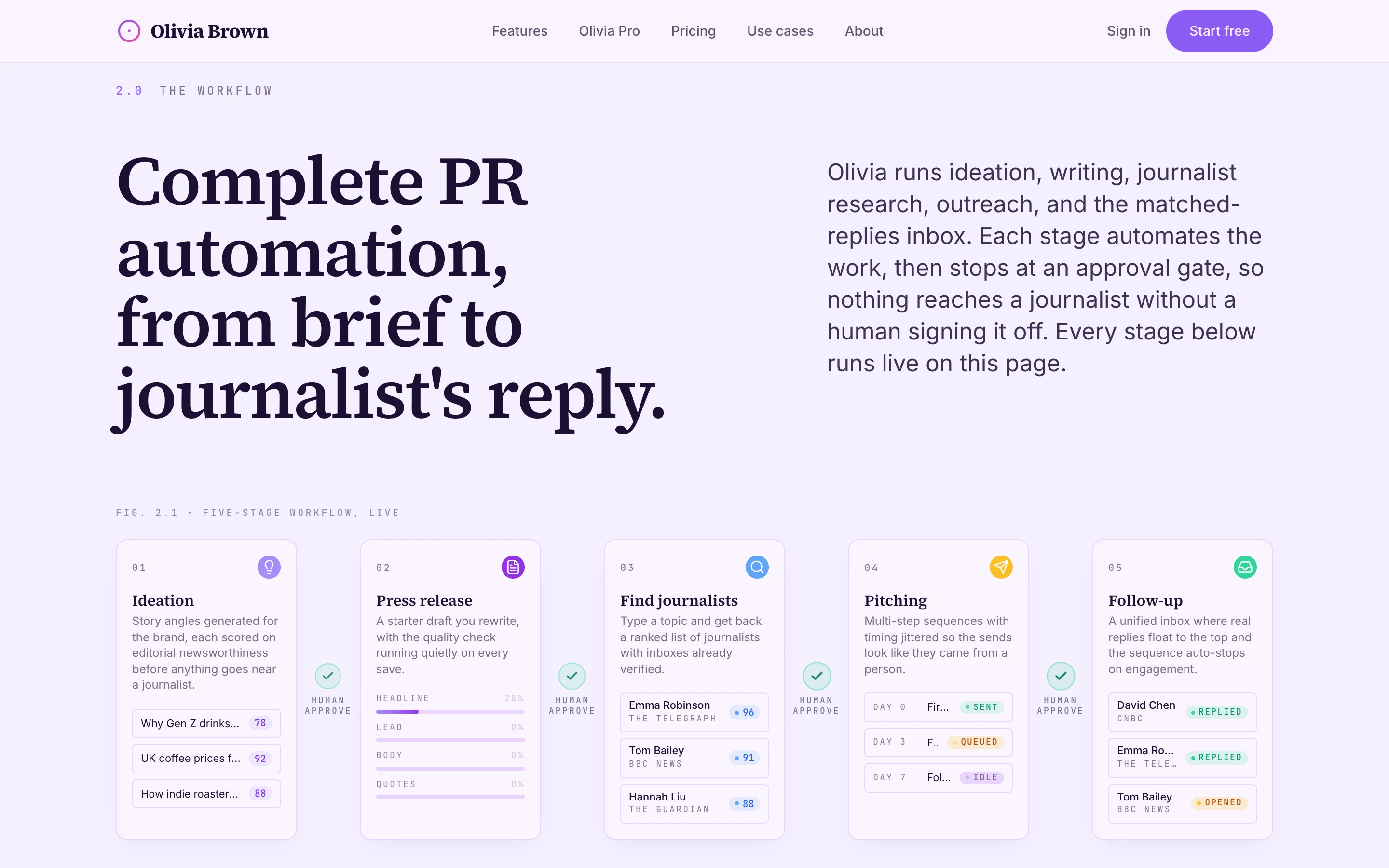
A campaign moves through ideation, press release, journalist research, pitching and follow-up. Each stage does its work and then waits at an approval gate, so a person signs off before anything reaches a journalist. A workspace picks one of three modes, from set-and-forget to approving both ideas and releases.
Fewer pitches, better aimed
Every press release is swept for AI-written text and scored for quality before it can be sent. That applies on the free plan too.
Stories go only to journalists whose recent bylines match the topic. In the example on the homepage, two of four recipients score below the relevance threshold and are dropped from the send.
What the free plan covers
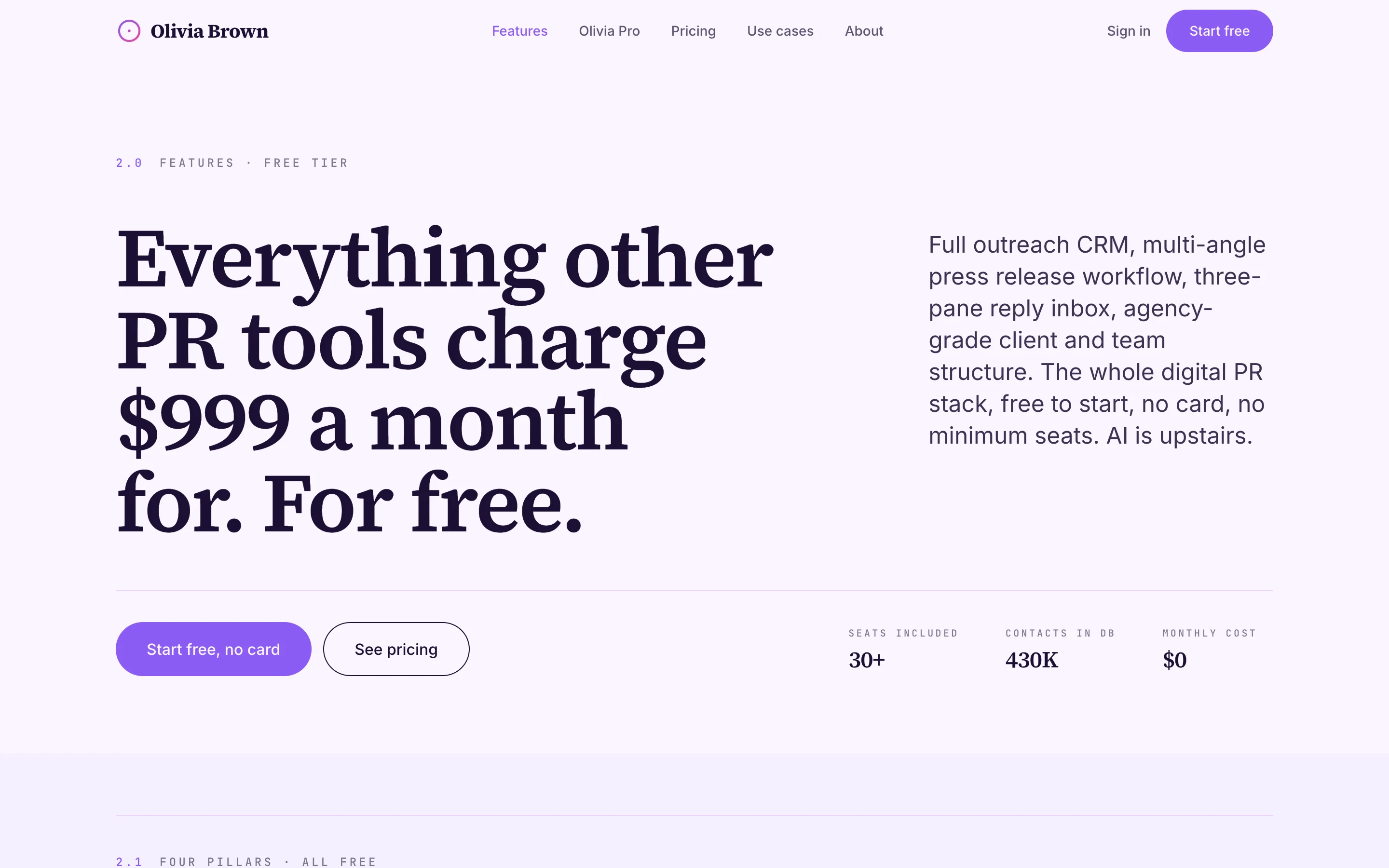
The free plan has no card, no time limit and no minimum number of seats. It includes multi-angle press releases, follow-up sequences that stop when a journalist replies, an inbox that threads every reply to the release behind it, client approval modes, team roles, and sending through the team's own Gmail, Outlook or SMTP account at up to 800 emails a day per user.
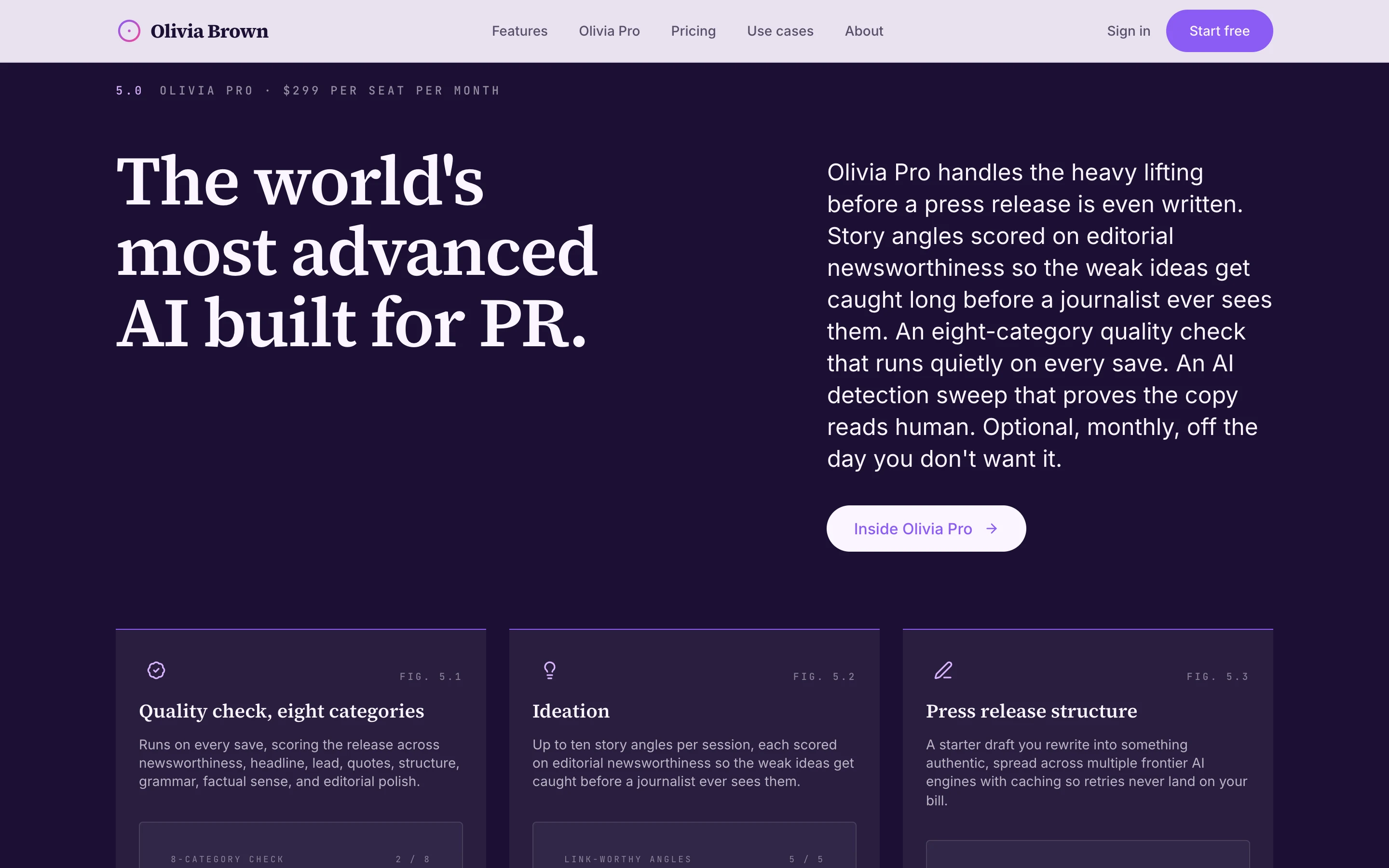
Olivia Pro is the paid tier, added only to the seats that need it. It brings scored story ideas, a starter draft, an eight-category quality check on every save, AI detection sentence by sentence and a daily scan for coverage.
Two releases, built from the end of 2024
Codekbyte built Olivia Brown for Search Intelligence, a digital PR agency in the UK. Work on the first public release started at the end of 2024 and took more than six months, and that release went live on 23 July 2025. Work on the current release began in April 2026, with a redesign and a new front end in React. The product site says the agency ran its campaigns this way for five years before the public launch, and puts the record at more than 100 million pitches delivered, a 99.8% delivery rate and spam complaints under 0.1%.
The name comes from the made-up byline the agency's writers used to sign drafts their editors had not yet seen.
What we built
Codekbyte designed and built the whole product: the interface, the application behind it and the AI features. The details below describe the product as it runs today. The services page covers the kinds of work involved.
Five stages with approval gates
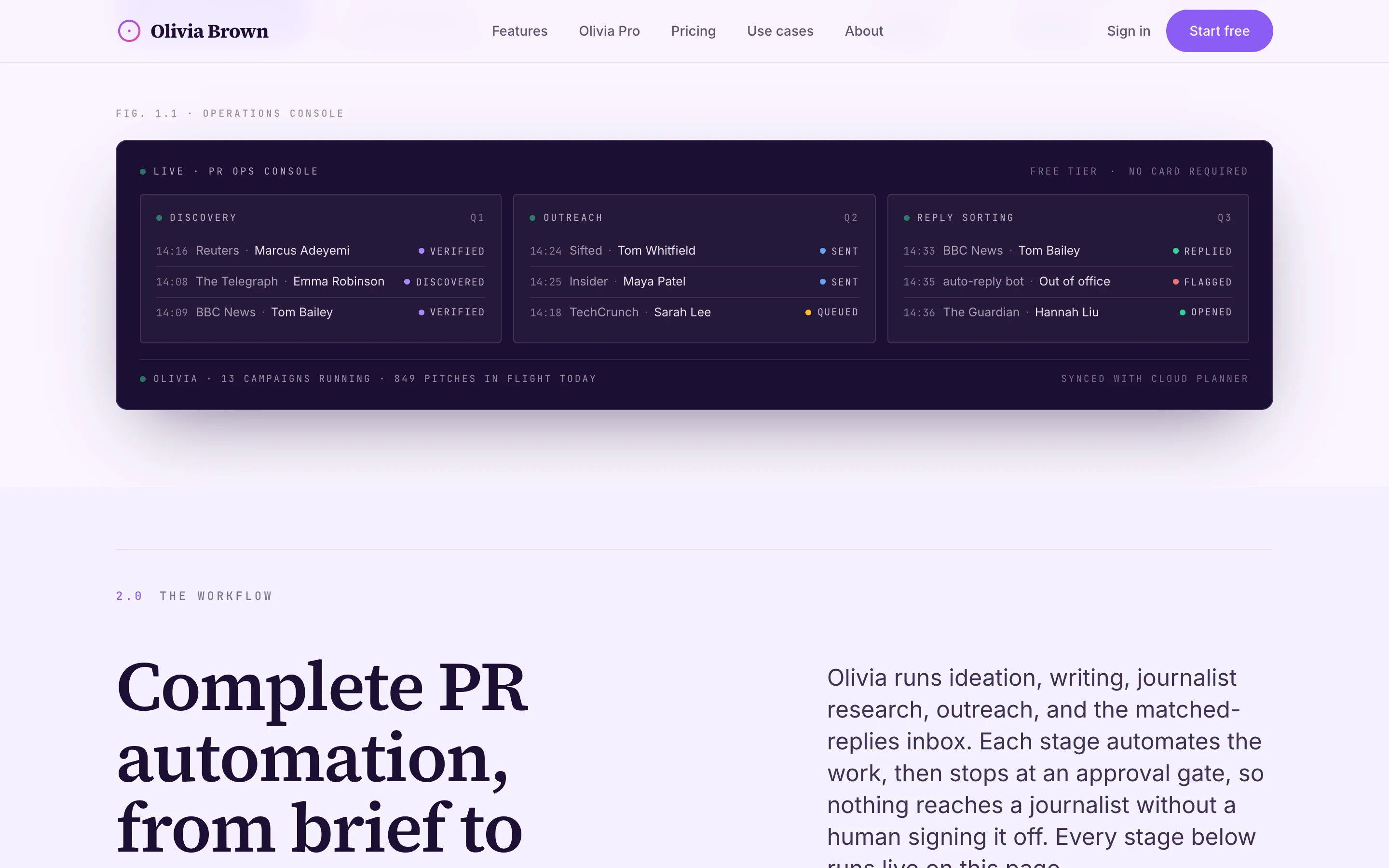
Ideation, press release, journalist research, pitching and follow-up run in order. Each stage stops at a gate, and a workspace chooses how many of them need a human sign-off.
A check before every send
Each press release passes an AI detection sweep and a quality check before it leaves the platform, on the free plan as well as the paid one.
Journalists matched by what they have written
Type a topic and get a ranked shortlist with verified inboxes, each journalist scored on how often their recent bylines covered the subject. Recipients below the relevance threshold are left off the list.
Multi-angle press releases
One release is cloned into several angles, each with its own subject line, folder and outreach sequence.
Follow-ups that stop on a reply
Sequences hold up to eight follow-ups, with varied send times, weekend-aware scheduling and a daily cap per account. They stop the moment the journalist answers.
One inbox for real replies
Every reply is threaded back to the release and recipient that triggered it. Journalist replies rise to the top while auto-responders, out-of-office notes and bounces sink.
Agency structure
Multiple clients, nested folders, a spokesperson library per client, five campaign roles and permission overrides for individual teammates.
Send from your own mailbox
Gmail, Outlook or custom SMTP, connected in about five minutes. Existing contacts come in by CSV alongside a built-in database of 430,000 journalist contacts.
Olivia Pro
The paid tier adds scored story ideas, a starter draft for each release, an eight-category quality check on every save, sentence-by-sentence AI detection, reply scoring and a daily scan for published coverage.
Figures from the product's own site
Published on oliviabrown.ai and quoted as they appear there.
- Journalist contacts in the built-in database
- 430K
- Emails per user through their own Gmail, Outlook or SMTP account
- 800 a day
- Pitches delivered
- 100M+
- Delivery rate
- 99.8%
- Spam complaints
- Under 0.1%
Screens
Captures of the public product. Select one to open it at full size.
Built with
The technologies Olivia Brown runs on today.
- Laravel
- Inertia.js
- React
- Tailwind CSS
More case studies
The other products we designed and built, each one live.
Tell us what you want built, or which developers your team is missing.
Send an enquiry